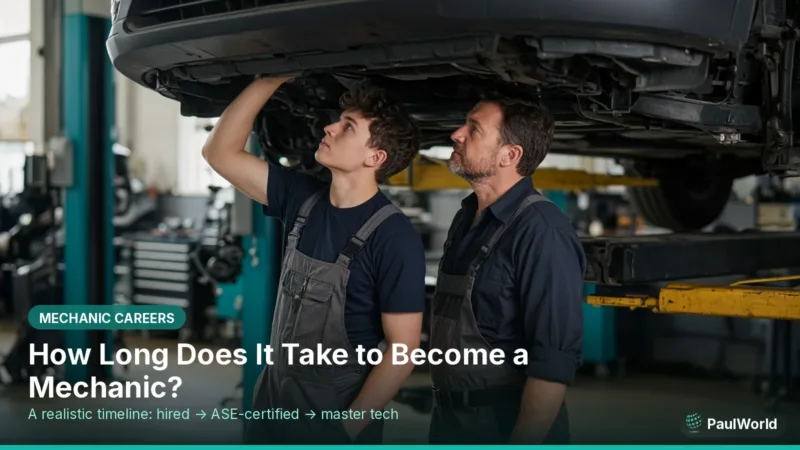
To become a mechanic, finish high school (or a GED), get hands-on training through a trade school, community college, or a paid apprenticeship, start in an entry-level shop job such as lube tech or technician helper, and then earn ASE certifications as you gain experience. Most people go from zero to a working automotive technician in about one to two years, and you can start without any prior experience if you are willing to learn on the job.
This guide walks through each step in order: the skills you need, the training options and what they cost, how to get hired with no experience, and how to keep moving up once you are in the shop.
What Does It Take to Be a Mechanic?
A modern mechanic, usually called an automotive service technician, inspects, maintains, and repairs cars and light trucks. According to the U.S. Bureau of Labor Statistics, technicians use computerized diagnostic tools as much as wrenches, and they also explain problems and repairs to customers (BLS Occupational Outlook Handbook).
The basic requirements are simple:
- Age: most shops hire technicians at 18 or older, mainly because of insurance rules. Teens of 16 or 17 can often work as shop helpers, porters, or tire and lube assistants, depending on state labor laws.
- Education: a high school diploma or GED is the usual minimum. A degree is not required.
- A valid driver’s license: you will move and road-test customer cars.
- Your own basic hand tools: employers usually own the lifts and big equipment, but technicians are expected to build their own set of wrenches, sockets, and ratchets over time.
Skills You Need to Be a Mechanic
The BLS lists the qualities that matter most, and they line up with what shop owners say they look for:
- Mechanical aptitude: understanding how parts fit and interact, and being able to take things apart and put them back together correctly.
- Problem solving: most of the job is diagnosis, not just replacing parts. You test, rule things out, and confirm the fix.
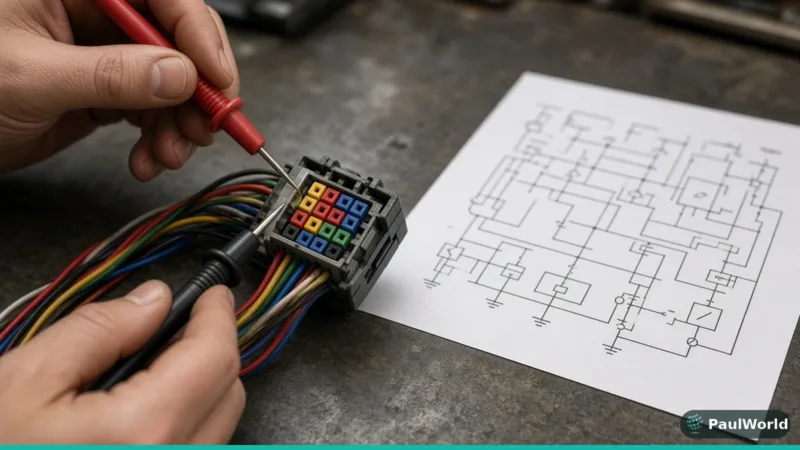
- Electrical and computer comfort: today’s cars are full of sensors, modules, and networks. Learning to use a scan tool and a multimeter is essential.
- Attention to detail: one loose connector or missed torque spec can bring a car back.
- Customer communication: you will explain what is wrong in plain language.
- Physical stamina: you stand most of the day, lift tires and parts, and work in awkward positions.
If you are still building the basics, our guide on how to learn about cars gives you a self-study roadmap, and how cars work explains the major systems you will service.
Step 1: Get a Foundation in High School (or on Your Own)
If you are still in school, take auto shop, electronics, computer, and math classes. Many high schools run automotive programs accredited by the ASE Education Foundation, and some let you take the entry-level ASE student certification tests before you graduate.
If you are already out of school, you can build the same foundation at home: do your own oil changes, brake pads, and filters on your own car, read a repair manual for your vehicle, and learn to read trouble codes. Our step-by-step guide on how to fix a car yourself is a good starting point.
Step 2: Choose Your Training Path
There is more than one way in. Here is how the three main routes compare.
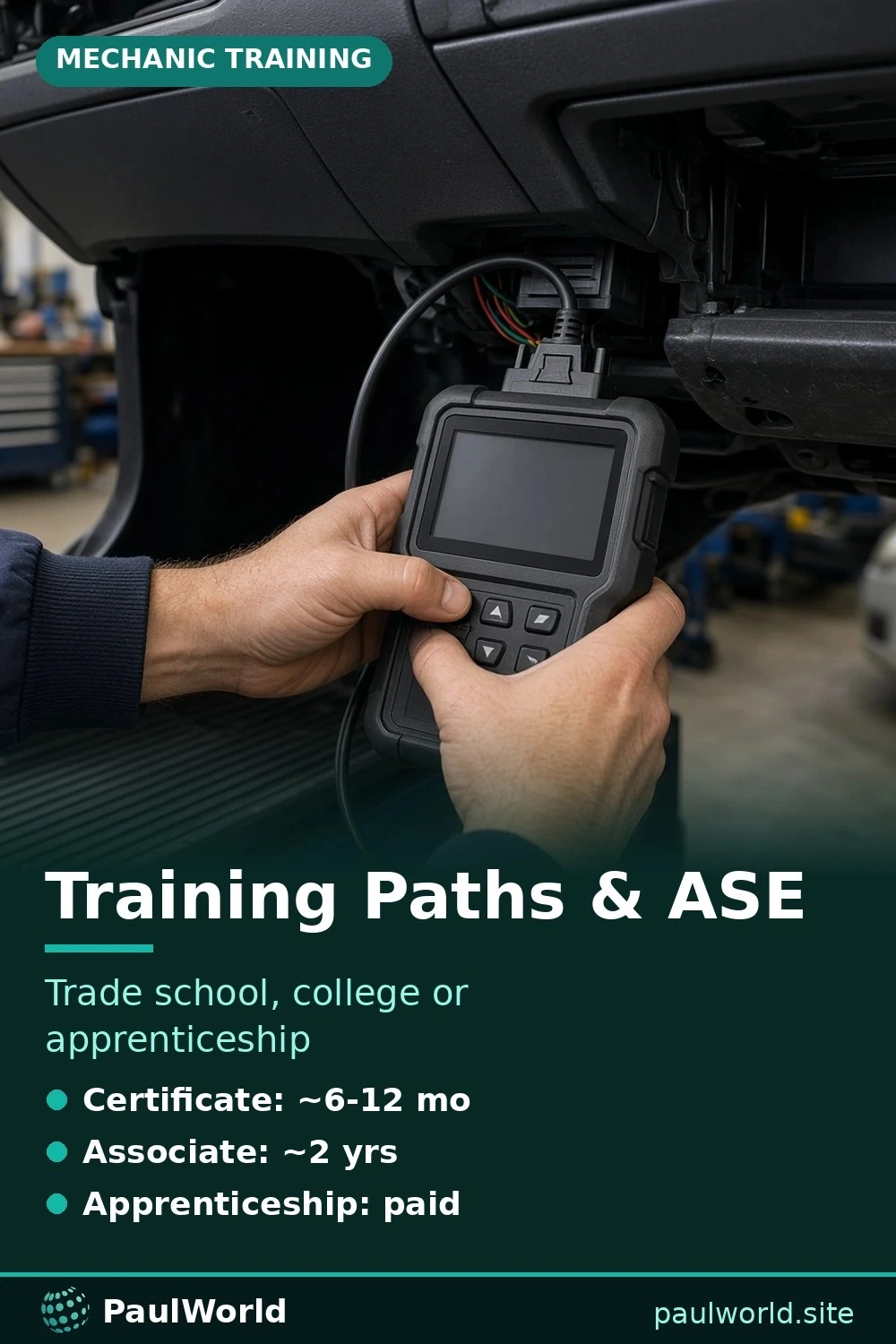
| Path | Typical length | Cost to you | Best for |
|---|---|---|---|
| Trade or technical school certificate | About 6 months to 1 year | Tuition varies widely by school | Fast, structured start with job placement help |
| Community college associate degree (AAS) | About 2 years | Usually lower per-credit tuition than private schools | Deeper theory, diagnostics, and a path to shop leadership |
| Apprenticeship or on-the-job training | About 1.5 to 2+ years | Little or none; you are paid while you learn | People who need to earn right away |
The BLS notes that technicians typically complete a postsecondary program in automotive service technology, though some enter with only a high school diploma and learn on the job. Graduates of formal programs usually need less on-the-job training before they work independently.
Trade School and Community College Programs
Look for programs accredited by the ASE Education Foundation, because they follow a curriculum built around the same tasks ASE tests. Ask each school about hands-on lab hours, the brands and equipment students actually work on, graduation and job-placement rates, and whether completing the program counts toward ASE’s work-experience requirement. Some programs are sponsored by automakers and focus on one brand’s vehicles, which can lead straight to a dealership job.
Apprenticeships
Registered apprenticeships combine paid shop work with classroom instruction. For example, the National Automobile Dealers Association’s Department of Labor-registered service technician apprenticeship runs 18 to 24 months and includes 2,000 hours of hands-on work and 405 hours of technical instruction (NADA). You can search for openings near you on Apprenticeship.gov.
How Much Does It Cost to Become a Mechanic?
Costs depend on your route. Community college programs are often the most affordable formal option, private technical institutes usually cost more, and apprenticeships cost little because the employer pays you. Budget separately for tools: a starter set of quality hand tools is a real expense, and many schools and tool suppliers offer student discounts. ASE tests also carry registration and per-test fees, which ASE lists on its registration page.
Step 3: Get Your First Job With No Experience
You do not need years of experience to get hired. Shops constantly need people for entry-level roles where you learn while you work:
- Lube technician / quick-service tech: oil changes, filters, fluid checks, and tire rotations.
- Tire technician: mounting, balancing, and rotating tires.
- Technician helper or apprentice: assisting a senior tech, cleaning parts, and doing basic tasks.
- Shop porter or detailer: moving cars and keeping the shop clean, often a foot in the door at dealerships.
To stand out with no experience:
- List any hands-on work you have done on your own or friends’ cars, with specific jobs (for example, “replaced front brake pads and rotors”).
- Show up in person at independent shops, dealership service departments, and tire chains, and ask for the service manager.
- Be honest about what you know and clear about wanting to learn.
- Mention any training you are enrolled in. Employers like hiring students because they are already committed.
The BLS reports that automobile dealers are the largest employer of automotive technicians, followed by independent repair and maintenance shops, so both are worth targeting.
Step 4: Earn ASE Certification
ASE (the National Institute for Automotive Service Excellence) certification is voluntary, but many employers prefer or require it, and it can lead to higher pay. To become certified, you must pass an ASE test and have documented hands-on work experience, typically one to three years depending on the test. Formal training can substitute for part of that experience. You can take the tests before you have the experience; you will get a score report, but you will not receive the certificate until your experience is approved (ASE work experience requirements).
Most new technicians start with the G1 (Auto Maintenance and Light Repair) test or the A-series tests in their strongest areas, such as A5 Brakes or A4 Suspension and Steering. Passing all of A1 through A8 earns ASE Master Automobile Technician status.
If you plan to work on air conditioning systems, note that the U.S. EPA requires technicians who buy or handle refrigerants to be certified (Section 609 for motor vehicle A/C).
Step 5: Keep Learning and Moving Up
A mechanic’s career is a ladder. Common steps look like this: lube or tire tech, then general service technician, then a specialist in brakes, drivability, electrical, transmissions, or EV and hybrid systems, then master technician, and finally shop foreman, service manager, or shop owner.
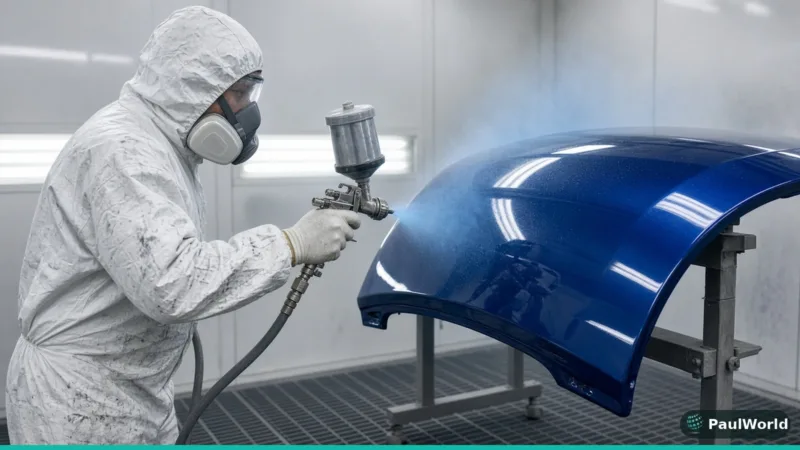
The fastest way to move up is to get better at diagnosis, especially electrical work. Learning how to read automotive wiring diagrams is one of the most valuable skills you can build early. Some technicians also branch into collision and refinishing work; see our guide on how to spray automotive paint if that side of the trade interests you.
Mechanic Pay and Job Outlook
The BLS reports a median annual wage of $50,620 for automotive service technicians and mechanics in May 2025, with the highest 10 percent earning more than $81,790. Technicians at automobile dealers had a higher median ($59,920) than those at most other employers. Employment is projected to grow 5 percent from 2025 to 2035, faster than the average for all occupations, with about 66,200 openings a year on average.
Pay depends on location, specialty, certifications, and how you are paid. Some shops pay hourly, while others use a flat-rate system where you are paid by the job, so speed and accuracy directly affect your income.
Which Training Path Fits You? A Side-by-Side Comparison
Every route below can lead to the same job. What changes is how you pay for it, how fast you earn, and how structured the learning is. Here is how they compare in practice.
| Path | Typical length | How you learn | Best for |
|---|---|---|---|
| Trade or technical school certificate | About 6 months to 1 year | Classroom plus school shop | People who want a fast, structured start |
| Community college associate degree | About 2 years | Deeper theory, electives, general education | Future shop leaders, diagnostic specialists |
| Manufacturer-sponsored program | Varies, often rotating school and dealer work | Brand-specific training in a dealer shop | Anyone set on working at a dealership |
| Apprenticeship | Often 2 to 4 years | Paid work alongside a mentor, plus instruction | People who need to earn while they learn |
| Military training | Weeks to months, then on-the-job | Formal military technical school | Recruits who want training and service |
| Start as a helper or lube tech | Ongoing | On-the-job, from oil changes upward | Self-starters with a shop willing to train |
Program lengths vary by school and state, so confirm the details with any program before you enroll.
Pro tip: When you tour a school, ask what percentage of class time is spent in the shop, which ASE areas the curriculum follows, and whether they help place graduates with local employers. Those three answers tell you more than the brochure.
Licenses and Certifications You May Actually Need
Most US states do not issue a general “mechanic license,” but a few specific credentials matter:
- EPA Section 609 certification: Federal rules require it before you service vehicle air-conditioning systems or buy certain refrigerants. It is an open-book test offered by several approved organizations.
- State inspection or emissions licenses: Some states require them if you perform official safety or emissions inspections.
- Shop registration: A few states regulate repair shops rather than individual technicians. If you plan to open your own shop, check your state’s consumer affairs or DMV office.
- ASE certification: Voluntary, but many employers prefer or reward it.
Common mistake: Buying a huge professional toolbox before your first job. Start with a quality basic set and add tools as the work demands. Many shops supply expensive specialty equipment such as scan tools, lifts, and A/C machines.
Choosing a Specialty Once You Are In
After a year or two of general work, most technicians lean toward an area they enjoy. Common directions include:
- Drivability and diagnostics: Chasing check-engine lights and intermittent faults. It suits people who like puzzles and electrical work.
- Brakes, steering, and suspension: Steady, high-volume work in almost every shop.
- Transmission and drivetrain: A specialized field, often found in dedicated shops.
- Hybrid and electric vehicles: Requires high-voltage safety training and is growing as more EVs reach the repair age.
- Diesel and fleet work: Trucks, buses, and company fleets, usually treated as a related but separate career track.
Whichever you choose, the habit that separates good technicians from great ones is the same: confirm the cause before replacing parts.
Frequently Asked Questions
Can I become a mechanic without going to school?
Yes. Some technicians start with a high school diploma and learn entirely on the job, often as a lube tech or helper. Formal training usually shortens the time it takes to work independently, but it is not legally required in most states.
How long does it take to become a mechanic?
Most people need about one to two years to become a working technician, whether through a certificate program, an associate degree, or an apprenticeship. Earning ASE certification takes additional documented experience on top of passing the test.
How old do you have to be to be a mechanic?
Most shops hire technicians at 18 or older. At 16 or 17, you may be able to work in a shop as a helper or porter, depending on state child labor rules and the employer’s insurance.
Do mechanics need a license?
Most states do not require a general mechanic license, but a few states and some localities regulate repair shops or certain kinds of work, and the EPA requires refrigerant certification for A/C work. Check your state’s rules before you start.
What is the difference between a mechanic and an automotive technician?
The terms are used interchangeably. “Technician” is the more common job title today because the work involves a lot of electronic diagnosis, but the job is the same.
Can you become a mechanic in the military?
Yes. Each branch of the US military trains vehicle and equipment mechanics through formal technical schools followed by on-the-job experience. That experience can count toward civilian jobs and ASE work-experience requirements.
Can women become mechanics?
Absolutely. The skills, training paths, and certifications are exactly the same for everyone. Many schools and industry groups run mentoring and scholarship programs aimed at bringing more women into the trade.
How do I become a mechanic with no experience?
Apply for entry-level roles such as lube technician, tire technician, or shop helper. Show up reliably, ask to shadow senior techs, and study for ASE entry-level tests in your spare time. Many technicians started exactly this way.
The Bottom Line
Becoming a mechanic is one of the most accessible skilled careers: you need a high school diploma, real hands-on training, an entry-level job to build experience, and ASE certifications to prove your skills. Start with whatever path fits your budget, keep learning diagnostics, and you can grow from your first oil change into a master technician.
Categories
Tags