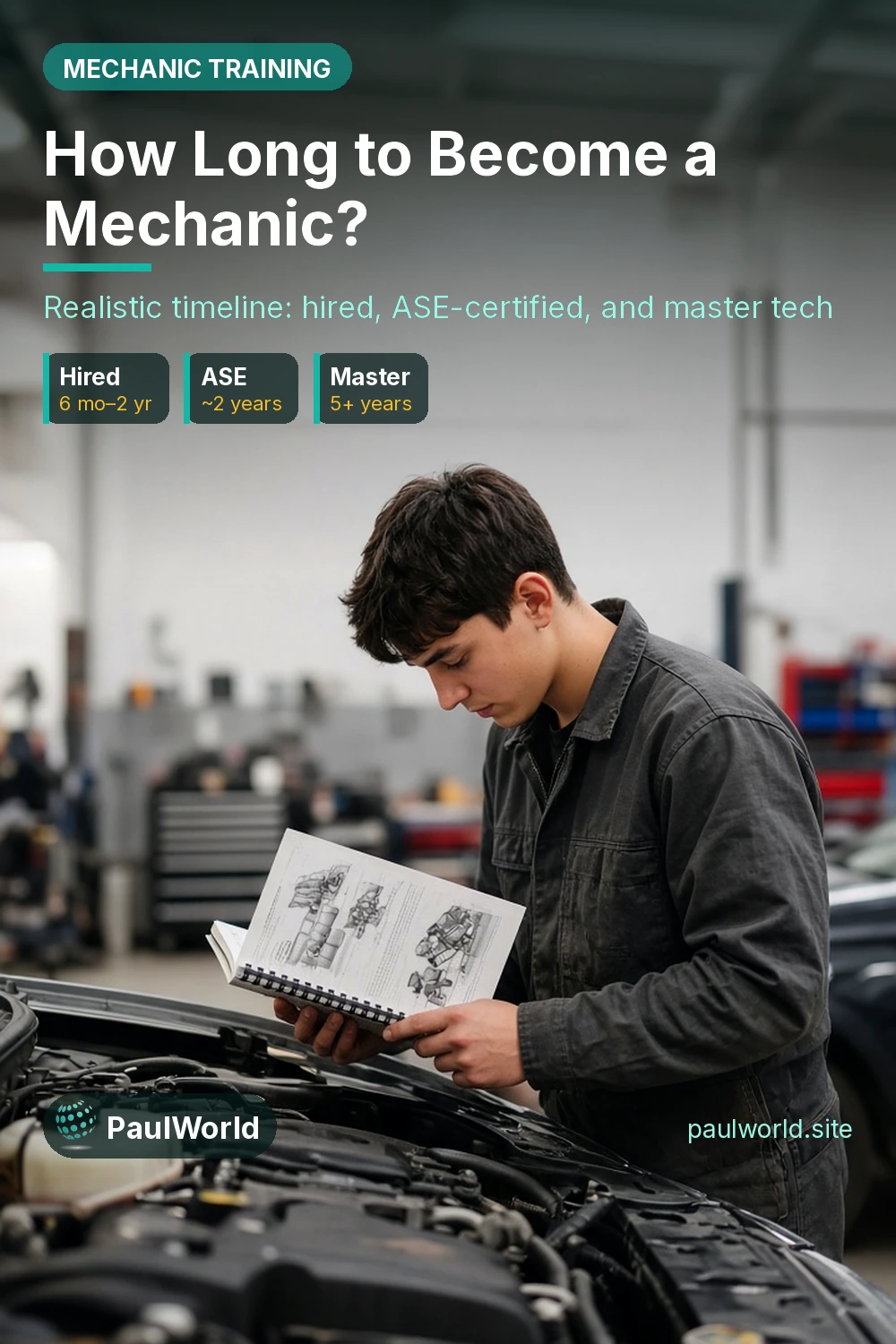
How long does it take to become a mechanic? Most people go from zero to a paid entry-level mechanic job in 6 months to 2 years, depending on whether they attend a 9- to 18-month trade school program or earn a 2-year associate degree; trainees hired straight into a shop can start within weeks. Earning ASE certification takes at least 2 years of hands-on experience (formal training can count for part of it), and becoming a fully independent, master-level technician usually takes several more years in the shop.
How long to become a mechanic really depends on which of three finish lines you mean: hired, certified, or master. This guide separates them, shows the real timeline for each training path, explains the ASE math most schools gloss over, and covers the moves that genuinely shorten the time it takes to become a mechanic.
The Three Finish Lines: Hired, Certified, and Master
The time it takes to become a mechanic depends on which milestone you mean. Hireable, certified, and master-level are separate goals, and each has its own clock.
| Milestone | What it means | Typical time from zero |
|---|---|---|
| 1. Hired | Paid entry-level job: lube tech, tire tech, general service, or apprentice/helper | Weeks (shop-trained) to about 2 years (after school) |
| 2. ASE-certified | Passed at least one ASE test and logged the required hands-on experience | About 2 years at the earliest |
| 3. Master / independent tech | ASE Master Automobile Technician (A1–A8) and trusted to diagnose almost anything alone | 2 years on paper at the earliest; in practice often 5+ years |
Most competitor answers blend these together. Keep them apart and you can plan your own timeline realistically, and you will not feel behind when a school graduate still starts on oil changes.
How Long to Become a Mechanic on Each Training Path
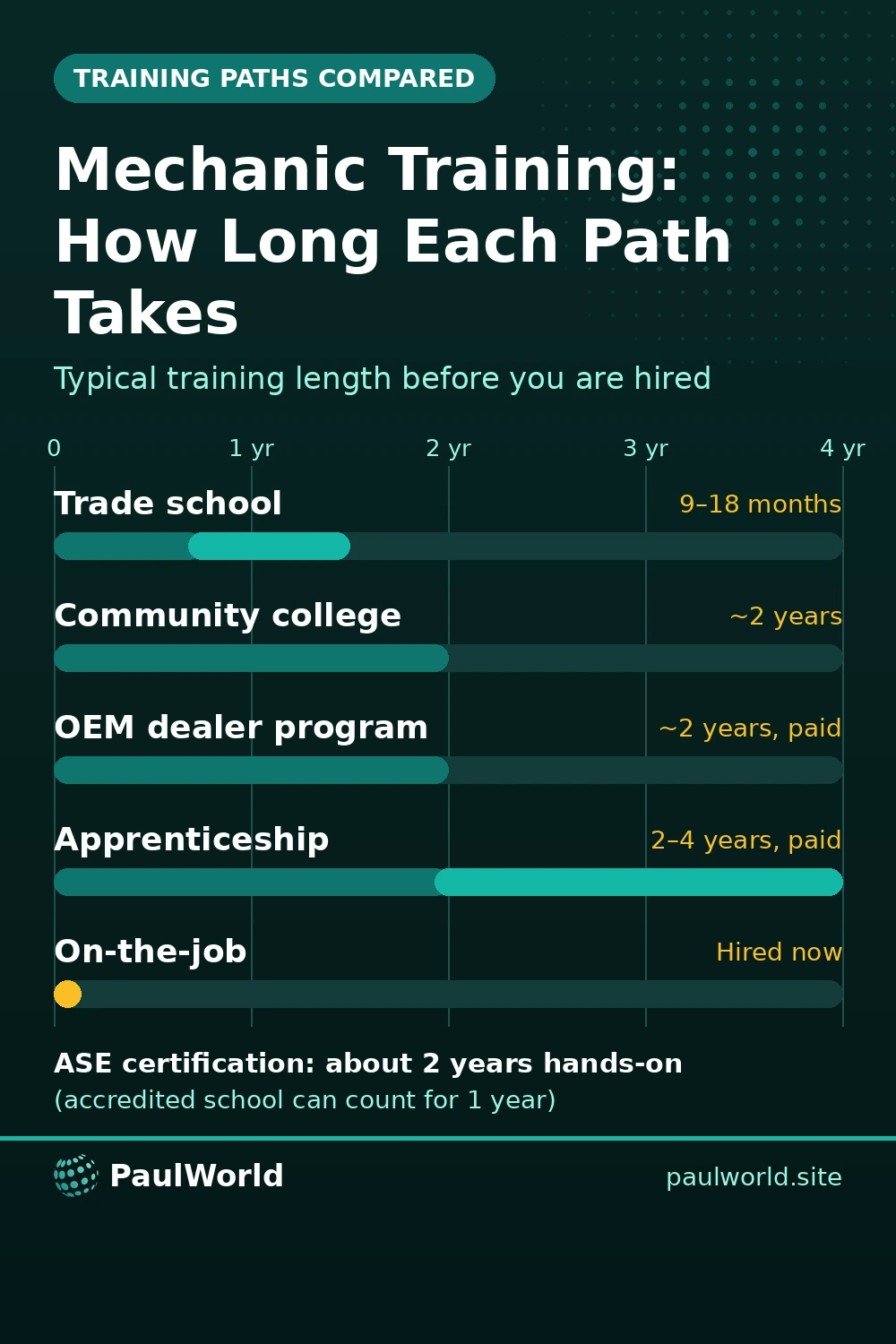
Here is how long it takes to become a mechanic on each of the common U.S. routes. Program lengths come from the schools’ own published figures, so always confirm the schedule at the campus you are considering.
| Path | Training length | When you are earning | Best for |
|---|---|---|---|
| On-the-job (no school) | No set length; you learn as a helper or lube tech | Immediately, at entry-level pay | People who need income now and have a shop willing to train |
| Trade school diploma or certificate | About 9–18 months (e.g., UTI’s core program is 51 weeks; Lincoln Tech lists 12–18 months) | After graduation, or part-time during school | Fast, structured start |
| Community college associate degree | About 2 years full-time | After graduation, or part-time during school | Lower tuition, a degree, room to move into management later |
| Manufacturer programs (Toyota T-TEN, GM ASEP, Ford ASSET) | Usually about 2 years, alternating class and dealership work | During the dealership rotations | Students who want to be dealer technicians for one brand |
| Registered apprenticeship | Commonly 2–4 years of paid work plus classroom instruction | From day one | Learning while earning, with a formal structure |
| Military vehicle maintenance | Varies by branch and enlistment | From day one | Those already considering service; skills transfer well |
On-the-job training: fastest to a paycheck, slowest to depth
You can be hired as a lube or tire tech with no formal training, sometimes within weeks. The U.S. Bureau of Labor Statistics notes that workers without a training program usually start as trainees, helpers, or lubrication workers and “require longer training periods.” The catch is that your pace depends entirely on your shop: a busy independent shop with patient senior techs can teach you fast, while a quick-lube chain may keep you on oil changes for a long time.
Trade school: about a year, then the real clock starts
A full-time trade school program typically runs 9 to 18 months. Evening schedules stretch that: Lincoln Tech’s Queens diploma, for example, lists roughly 52 weeks on day or afternoon classes but about 78 weeks in the evening for the same 1,560 instructional hours. Graduates usually still start at the entry level, but BLS notes they need a relatively short period of on-the-job training compared with untrained hires.
Community college and manufacturer programs: about 2 years
An associate degree in automotive technology takes about two years full-time and includes some general education. Manufacturer-sponsored programs such as Toyota T-TEN, GM ASEP, and Ford ASSET also run about two years, but you alternate between class and paid dealership rotations (Ford ASSET, for example, alternates roughly six to eight weeks in class with six to eight weeks at a sponsoring dealer). By graduation you have both training and real shop hours on your record.
Apprenticeships: 2 to 4 years, paid the whole way
Apprenticeships combine paid on-the-job training with technical instruction. U.S. programs vary by employer and state, so the length is set by the sponsor. If you see results claiming “4 to 5 years,” they are often Canadian: Ontario’s automotive service technician apprenticeship, for instance, requires 6,500 on-the-job hours plus three 8-week classroom sessions, and Saskatchewan requires 7,200 trade hours over at least four years. Most U.S. states do not require a formal apprenticeship to work as a car mechanic, so in the U.S. it is one option, not the only route.
How Long Does ASE Certification Take?
ASE certification takes about two years for most mechanics, because you need both a passing test score and two years of relevant hands-on experience for the automobile (A-series) tests. Formal training from an accredited program can substitute for up to one of those years.
Three details make a big difference to your timeline:
- You can test before you qualify. ASE lets you take most tests before you have the required experience. You get a score report right away, and the certificate is issued once your work experience is approved. That means you can pass tests while still in school or in your first year on the job.
- School can count as one year. Graduating from an ASE-accredited program (UTI and many community colleges advertise this) covers one of the two required years, so you need only one more year of full-time work.
- A failed test costs you about a month. If you fail, you must wait 30 days before you can buy that test again, so schedule tests with your study time in mind.
The full rules, including the separate one-year and three-year requirements for some tests, are on ASE’s own work experience requirements page.
How long does it take to become an ASE Master Technician?
The fastest realistic route to ASE Master Automobile Technician status is about two years: one year of accredited training plus one year of full-time work, while passing all eight tests from A1 (Engine Repair) to A8 (Engine Performance). The A9 light vehicle diesel test is not required for master status. In practice, most techs take longer, because passing A6 (Electrical/Electronic Systems) and A8 (Engine Performance) usually takes real diagnostic experience, not just book study. Certifications also expire after five years, so recertification becomes part of the long-term timeline.
A Realistic Year-by-Year Timeline (Trade School Route)
Here is what the first five years commonly look like for someone who starts at a trade school and then works full-time in a shop. Titles and pace vary by shop, so treat this as a planning guide rather than a guarantee.
- Months 0–12: Training. Core program covering engines, brakes, suspension, electrical, HVAC, and engine performance. If you can, work part-time at a shop or parts store. Take the EPA Section 609 refrigerant certification, which is required to buy or work with automotive refrigerants and can be done quickly.
- Year 1–2: Entry-level tech. Oil services, tires, brakes, inspections, and simple repairs, often as a lube tech or general service tech. Start passing ASE tests: A5 (Brakes) and A4 (Suspension and Steering) are common first targets because you see that work every day.
- Year 2–3: Line technician. Your experience clock completes and your ASE certificates are issued. You take on bigger jobs, such as timing components, cooling systems, and driveability complaints with clear codes.
- Year 3–5: Diagnostic or senior tech. Electrical and driveability diagnosis, intermittent problems, and module programming. Many techs complete A1–A8 in this window and start specializing (EVs and hybrids, diesel, transmissions, or a single brand at a dealer).
- Year 5 and beyond: Master-level, lead tech, or shop foreman. You are trusted with the hardest jobs, mentor newer techs, or move toward service management.
Someone who skips school can follow the same ladder, but should expect the early stages to take longer unless their shop invests in training.
What Speeds Up (or Slows Down) the Time It Takes
The biggest accelerator is stacking shop hours while you train. A part-time job at a shop during school means you graduate with experience, references, and part of your ASE experience already logged.
Things that shorten your timeline
- Working while you study. Even a lube-and-tire job builds speed, tool skills, and shop habits that school labs cannot.
- Choosing a shop that trains. Ask in the interview who you will work with and how new techs move up. A mentor matters more than the sign on the building.
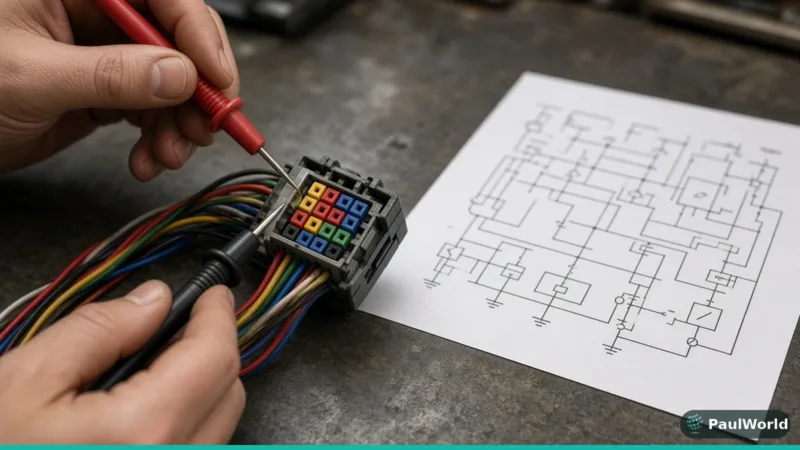
- Learning electrical early. Electrical diagnosis is where many techs stall. Getting comfortable reading automotive wiring diagrams and using a multimeter puts you ahead of most of your class.
- Testing early and often. Pass ASE tests as soon as you are ready, since certificates are issued when your experience catches up.
- Practicing at home. Working on your own or family cars, with a diagnosis-first approach to car repair, turns classroom theory into muscle memory.
Things that slow it down
- Staying in a quick-lube role with no path to bigger work.
- Evening or part-time school without any shop job alongside it.
- Avoiding diagnostic work because it feels hard. It is the skill that pays.
- Not buying basic tools. BLS notes that technicians typically own their hand tools, and a shop cannot give you jobs you cannot tool up for.
Is the Time Investment Worth It?
For most people who like hands-on problem-solving, yes. According to the BLS, automotive service technicians and mechanics earned a median of $50,620 in May 2025, with the top 10 percent earning more than $81,790, and about 66,200 openings are projected each year from 2025 to 2035. Pay usually rises with certification, diagnostic skill, and specialty, which is why the years after you are hired matter as much as the school you choose.
If you are still deciding whether this career is for you, start with our step-by-step guide to becoming a mechanic for the skills, costs, and first-job advice, or build confidence first by learning car basics on your own.
Common Mistakes That Waste Time
- Thinking a diploma makes you a finished tech. Every new tech starts at the entry level. School shortens the climb; it does not skip it.
- Picking a program only by length. A 9-month course without ASE accreditation may not give you the one-year experience credit an accredited program does.
- Waiting to take ASE tests “until you’re ready for all of them.” Take them one or two at a time as your skills grow.
- Ignoring manufacturer programs. If you want to work at a dealer, a two-year OEM program can put you on a brand’s training path from day one.
Frequently Asked Questions
How many years does it take to become a mechanic?
Plan on 1 to 2 years to become a hireable entry-level mechanic through school, about 2 years to become ASE-certified, and often 5 years or more to reach master-level skill. You can start working much sooner as a lube or tire tech while you learn.
How long is automotive technician school?
Automotive technician school usually takes 9 to 18 months for a diploma or certificate and about 2 years for an associate degree. Evening schedules can add several months to the same program.
How many years of college do you need to be a mechanic?
None are strictly required. BLS lists a postsecondary nondegree award, such as a trade school certificate, as the typical entry-level education. A 2-year associate degree is optional but can help with dealer jobs and later management roles.
Can you become a mechanic in 6 months?
You can get an entry-level shop job in 6 months or less, and some short programs cover the basics in that time. Becoming a well-rounded technician takes longer, because diagnostic skill comes from real repair experience.
How long does it take to become a mechanic with no experience?
With no experience and no school, you can usually be hired as a helper or lube tech quickly, but plan on at least 2 years of steady shop work before you can earn ASE certification and handle most repairs on your own.
Is it faster to become a mechanic through an apprenticeship or school?
School gets you trained faster (often in about a year), while an apprenticeship gets you paid faster. Over 2 to 3 years, both can lead to the same place: an ASE-certified line technician.
The Bottom Line
So, how long does it take to become a mechanic? Expect up to about 2 years to get trained and hired, about 2 years to earn your first ASE certifications, and several more years of focused shop work to reach master level. Stack shop hours while you learn, test early, and pick a shop that trains, and you will reach each milestone faster than most.
Categories
Tags